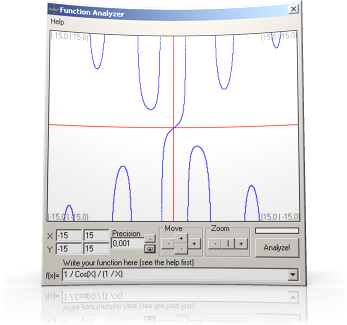
Function Analyzer is a program that permits you to see the graph of a function like f(x)=<x expression>.
In this picture you can see the graph of this function: f(x)=1/Cos(x)/(1/X)
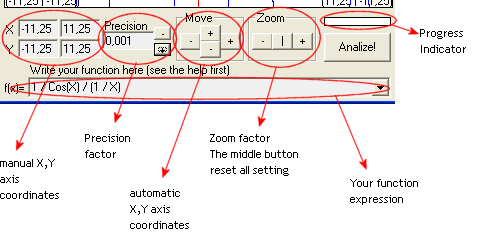
The usage is very simple: - Write the function expression in the bottom combo box or choose and modify a predefined one (see the list of recognized keywords). - Press the 'Analyze' button to show the graph.
After this you can: - Move the X,Y axis, zoom in/out, increase/decrease precision (more precision you use more time the program take to process the expression).
In order to parse complex expressions I've created a parser using GOLD Parser Builder by Devin Cook giving it a BNF rule grammar created by me ;-). After this, the GOLD Parser Builder creates a skeleton program I've used to parse expressions. The BNF sintax used is present in the program installation folder (expression.grm).
Function Analyzer can parse a mathematic expression recognizing valid the following words: - operators like: - + - * / - ^ (power) - numbers like: - integer ex. 100 - float ex. 100.52 (use the . for decimals) - hexadecimal ex. &hFF (255) - octal ex. &o22 - x (is the variable) - e (is ~ 2.718282) - cos ( <Expr> ) -> the cosine of an angle - sin ( <Expr> ) -> the sine of an angle - tan ( <Expr> ) -> the tangent of an angle - atn ( <Expr> ) -> the arctangent of a number - log ( <Expr> ) -> natural logarithm of a number - sgn ( <Expr> ) -> the sign of a number - sqr ( <Expr> ) -> the square root of a number - exp ( <Expr> ) -> e (the base of natural logarithms) raised to a power - sec ( <Expr> ) -> Secant = 1 / Cos(X) - cosec ( <Expr> ) -> Cosecant = 1 / Sin(X) - cotan ( <Expr> ) -> Cotangent = 1 / Tan(X) - arcsin ( <Expr> ) -> Inverse Sine = Atn(X / Sqr(-X * X + 1)) - arccos ( <Expr> ) -> Inverse Cosine = Atn(-X / Sqr(-X * X + 1)) + 2 * Atn(1) - arcsec ( <Expr> ) -> Inverse Secant = Atn(X / Sqr(X * X - 1)) + Sgn((X) -1) * (2 * Atn(1)) - arccosec ( <Expr> ) -> Inverse Cosecant = Atn(X / Sqr(X * X - 1)) + (Sgn(X) - 1) * (2 * Atn(1)) - arccotan ( <Expr> ) -> Inverse Cotangent = Atn(X) + 2 * Atn(1) - hsin ( <Expr> ) -> Hyperbolic Sine = (Exp(X) - Exp(-X)) / 2 - hcos ( <Expr> ) -> Hyperbolic Cosine = (Exp(X) + Exp(-X)) / 2 - htan ( <Expr> ) -> Hyperbolic Tangent = (Exp(X) - Exp(-X)) / (Exp(X) + Exp(-X)) - hsec ( <Expr> ) -> Hyperbolic Secant = 2 / (Exp(X) + Exp(-X)) - hcosec ( <Expr> ) -> Hyperbolic Cosecant = 2 / (Exp(X) - Exp(-X)) - hcotan ( <Expr> ) -> Hyperbolic Cotangent = (Exp(X) + Exp(-X)) / (Exp(X) - Exp(-X)) - harcsin ( <Expr> ) -> Inverse Hyperbolic Sine = Log(X + Sqr(X * X + 1)) - harccos ( <Expr> ) -> Inverse Hyperbolic Cosine = Log(X + Sqr(X * X - 1)) - harctan ( <Expr> ) -> Inverse Hyperbolic Tangent = Log((1 + X) / (1 - X)) / 2 - harcsec ( <Expr> ) -> Inverse Hyperbolic Secant = Log((Sqr(-X * X + 1) + 1) / X) - harccosec ( <Expr> ) -> Inverse Hyperbolic Cosecant = Log((Sgn(X) * Sqr(X * X + 1) +1) / X) - harccotan ( <Expr> ) -> Inverse Hyperbolic Cotangent = Log((X + 1) / (X - 1)) / 2 - log2 ( <Expr> ) -> Base 2 logarithm of a number - log8 ( <Expr> ) -> Base 8 logarithm of a number - log10 ( <Expr> ) -> Base 10 logarithm of a number - log16 ( <Expr> ) -> Base 16 logarithm of a number
Obviously an expression can be very complex.
Some examples:
f(x)=harccosec(log(x)*cos(x+1*2)) f(x)=Atn(X / Sqr(X * X - 1)) + Sgn((X) -1) * (2 * Atn(1)) <--this is the arcsec equation f(x)=x^2
Operators precedence:
Works as you expect; first Function Analyzer executes unary expressions (- +), then binary in this order (^, * /, + -), then all others above functions.
So the expression f(x)=3+2*6 gives 15 and not 30. You can apply '()' to this expression so f(x)=(3+2)*6 gives 30